In today’s rapidly evolving digital landscape, investing in bespoke solutions is no longer a luxury but a strategic imperative for businesses aiming for a competitive edge. However, a common hurdle for both burgeoning startups and established enterprises is demystifying the custom software development cost. Understanding the financial commitment involved is crucial for effective budgeting, ensuring a robust return on investment (ROI), and ultimately, driving innovation.
At DB CodeCraft, we understand that transparency and predictability are paramount. This guide aims to pull back the curtain on custom software development expenses, outlining the key drivers, strategic approaches to managing budgets, and how a partnership with an expert agency can transform a perceived cost into a powerful asset.
Understanding the Landscape of Custom Software Development Cost
Unlike off-the-shelf solutions with fixed pricing, custom software development offers unparalleled flexibility and tailored functionality, but its cost can seem opaque. This perceived complexity often stems from the unique nature of each project – no two custom applications are ever truly identical. The financial outlay isn’t merely about lines of code; it encompasses meticulous planning, innovative design, rigorous testing, and ongoing support.
Why Invest in Custom Software?
Before diving into costs, it’s essential to reiterate the inherent value of custom software:
- Tailored Functionality: Solutions built precisely to your business processes and user needs, eliminating unnecessary features and filling critical gaps.
- Competitive Advantage: Proprietary software can offer unique capabilities that competitors cannot easily replicate.
- Scalability: Designed to grow with your business, accommodating future demands without requiring a complete overhaul.
- Enhanced Efficiency: Automating workflows and integrating disparate systems leads to significant operational improvements.
- Security & Compliance: Built with specific industry regulations and security protocols in mind from day one.
Key Drivers of Custom Software Development Cost
Several interconnected factors dictate the final price tag of a custom software project. Understanding these drivers is the first step towards managing your budget effectively.
Scope and Complexity
This is arguably the most significant cost driver. The more features, integrations, user roles, and intricate logic your software requires, the higher the development effort and, consequently, the cost. A clear, well-defined scope is vital to control custom software development cost.
- Number of Features: Each unique function requires development, testing, and integration time.
- Third-Party Integrations: Connecting with existing systems (CRMs, ERPs, payment gateways) adds complexity.
- User Roles & Permissions: Implementing different access levels for various user types.
- Data Migration: Transferring existing data to the new system can be a substantial effort.
- Algorithmic Complexity: Advanced AI, machine learning, or complex data processing can increase development time significantly.
Technology Stack
The choice of programming languages, frameworks, databases, and cloud infrastructure directly impacts cost. While some technologies might have steeper learning curves or require more specialized talent, they often offer superior performance, scalability, or security in the long run. DB CodeCraft specializes in modern, robust technologies like React, Node.js, Next.js, WordPress, and PHP, ensuring efficient and scalable solutions.
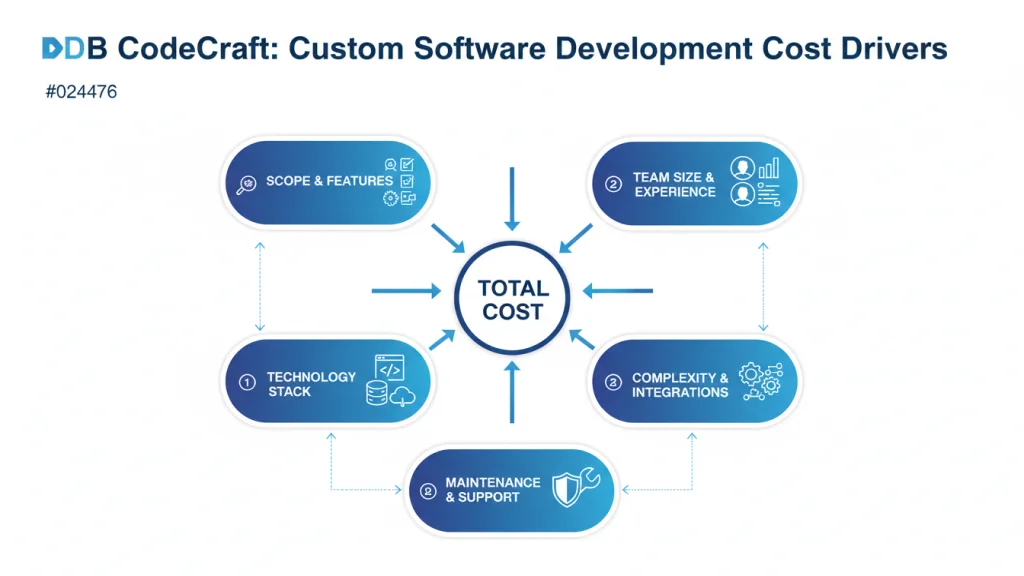
Team Size and Expertise
The hourly rates of developers, designers, project managers, and quality assurance specialists vary based on their experience, location, and specific skill sets. A senior developer, while more expensive per hour, often delivers higher quality code faster and with fewer issues than a junior counterpart, potentially reducing overall custom software development cost.
- Project Manager: Oversees the project, manages timelines and budgets.
- UI/UX Designer: Crafts intuitive and engaging user interfaces.
- Frontend Developers: Build the user-facing parts of the application.
- Backend Developers: Develop the server-side logic, databases, and APIs.
- QA Testers: Ensure the software is bug-free and meets requirements.
- DevOps Engineers: Manage infrastructure, deployment, and scalability.
Project Methodology
Agile methodologies, common in custom software development, offer flexibility and iterative progress, allowing for adjustments along the way. While this can lead to better outcomes, it requires continuous client engagement. Fixed-price projects, on the other hand, offer budget predictability but less flexibility once the scope is locked. Understanding the nuances of project management is key to navigating the overall investment. For more insights into effective project management, consider resources like the Project Management Institute.
Maintenance and Post-Launch Support
The initial development cost is not the end of the financial journey. Ongoing maintenance, security updates, bug fixes, performance monitoring, and future feature enhancements are all part of the total cost of ownership. Strategic planning for these post-launch activities is crucial for the long-term success and relevance of your custom software.
Custom Software Development Cost: A Breakdown by Project Type
While every project is unique, we can categorize typical cost ranges based on the project’s ambition and target audience:
MVP for Startups: Lean & Strategic Investment
For startups, the focus is often on a Minimum Viable Product (MVP). This approach minimizes initial custom software development cost by focusing on core features that solve a critical problem for early adopters. It allows for market validation and iterative development based on user feedback, proving the concept before significant scaling.
An MVP typically involves:
- Essential features only (no bells and whistles).
- Basic, functional UI/UX.
- Single platform (web or mobile).
- Limited integrations.
Enterprise-Grade Solutions: Scalability & Robustness
Enterprises often require complex, highly scalable, and secure applications that integrate deeply with existing legacy systems. These projects usually involve larger teams, extensive testing, advanced security protocols, and compliance considerations, leading to higher custom software development costs but also delivering massive strategic value and operational efficiencies.
Enterprise solutions often feature:
- Extensive feature sets and complex business logic.
- High availability and robust security measures.
- Multiple third-party system integrations.
- Scalability for millions of users or complex data processing.
- Comprehensive reporting and analytics.
Strategies for Managing and Optimizing Custom Software Development Cost
Controlling costs doesn’t mean compromising quality. It’s about smart planning and strategic execution.
1. Detailed Requirements Gathering and Documentation
Ambiguity is the enemy of budget predictability. Clear, concise, and comprehensive requirements documentation significantly reduces scope creep and rework, directly impacting the overall custom software development cost. Invest time upfront in defining what you need.
2. Phased Development (MVP First)
As mentioned for startups, this strategy is also highly effective for enterprises. Breaking down a large project into smaller, manageable phases allows for early market testing, reduces initial investment, and provides opportunities to adjust course based on real-world feedback. This iterative approach helps maintain control over the budget.
3. Choosing the Right Partner
Your development partner is your co-pilot on this journey. Look for an agency with a proven track record, transparent communication, and a deep understanding of your industry. A reliable partner like DB CodeCraft can provide accurate estimates, strategic guidance, and efficient execution. Explore our comprehensive IT services to see how we align with your project needs.
4. Leveraging Existing Solutions (Where Appropriate)
Don’t reinvent the wheel if you don’t have to. Utilizing robust open-source components, APIs for standard functionalities (e.g., mapping, analytics), or pre-built modules can significantly reduce development time and custom software development cost. For example, understanding Web APIs can highlight opportunities for integration rather than custom building.
5. Prioritizing Features for Maximum ROI
Work with your development partner to identify the most impactful features that deliver the highest business value. Postpone non-essential features for future phases. This strategic prioritization ensures your initial investment yields the greatest possible return.
The DB CodeCraft Advantage: Predictable Custom Software Development Cost & Unmatched Value
At DB CodeCraft, we believe that investing in custom software should be an empowering experience, not a daunting one. Our approach is built on transparency, collaboration, and a deep commitment to delivering tangible business value. We work closely with both startups and enterprises to:
- Define Clear Roadmaps: Meticulous planning to outline scope, timelines, and predictable custom software development cost.
- Leverage Modern Tech Stacks: Utilizing React, Node.js, Next.js, WordPress, and PHP for efficient, scalable, and future-proof solutions.
- Provide Expert Teams: Our seasoned professionals bring a wealth of experience to every project, ensuring high-quality output and efficient execution.
- Foster Agile Collaboration: Keeping you informed and involved at every stage, allowing for flexibility and alignment with your evolving business goals.
- Ensure Post-Launch Success: Offering ongoing support and maintenance to keep your software performing optimally.
Don’t let uncertainty about custom software development cost deter you from building the solution your business truly needs. With DB CodeCraft, you gain a partner dedicated to turning your vision into a successful, cost-effective reality. Explore our success stories and see the impact of our work on our portfolio page.
Conclusion: Strategic Investment for Future Growth
Understanding the intricacies of custom software development cost is crucial for making informed decisions that drive long-term success. While the investment can be significant, the strategic advantages of tailored functionality, scalability, and competitive differentiation far outweigh the initial outlay when planned and executed correctly. By focusing on clear requirements, phased development, and partnering with an experienced agency like DB CodeCraft, both startups and enterprises can achieve predictable budgets and maximize their ROI.
Ready to explore how custom software can transform your business without breaking the bank? Contact DB CodeCraft today for a consultation and let’s craft your future, together.