In today’s competitive digital landscape, successful SaaS product development hinges on choosing the right technologies to ensure scalability, performance, and an exceptional user experience. For startups aiming to disrupt markets and enterprises seeking to modernize their offerings, React and Next.js emerge as a powerful combination, providing a robust foundation for building future-proof software-as-a-service applications.
The Foundation: Why React and Next.js for SaaS Product Development?
The journey of building a successful SaaS product often starts with a critical technology decision. React and Next.js offer a compelling suite of features that address the core demands of modern web applications, particularly for the dynamic and data-intensive nature of SaaS product development.
Rapid Prototyping and Iteration
React’s component-based architecture is a game-changer for rapid development. By breaking down the UI into reusable, self-contained components, developers can build complex interfaces with remarkable speed and maintainability. This modularity not only accelerates initial prototyping but also streamlines subsequent iterations and feature additions, a crucial advantage in the fast-paced world of SaaS.
Next.js further enhances this by providing an opinionated framework that handles routing, data fetching, and build processes out of the box. This means less time spent configuring and more time building, allowing teams to quickly bring their SaaS vision to life and adapt to market feedback.
Unmatched Performance and User Experience
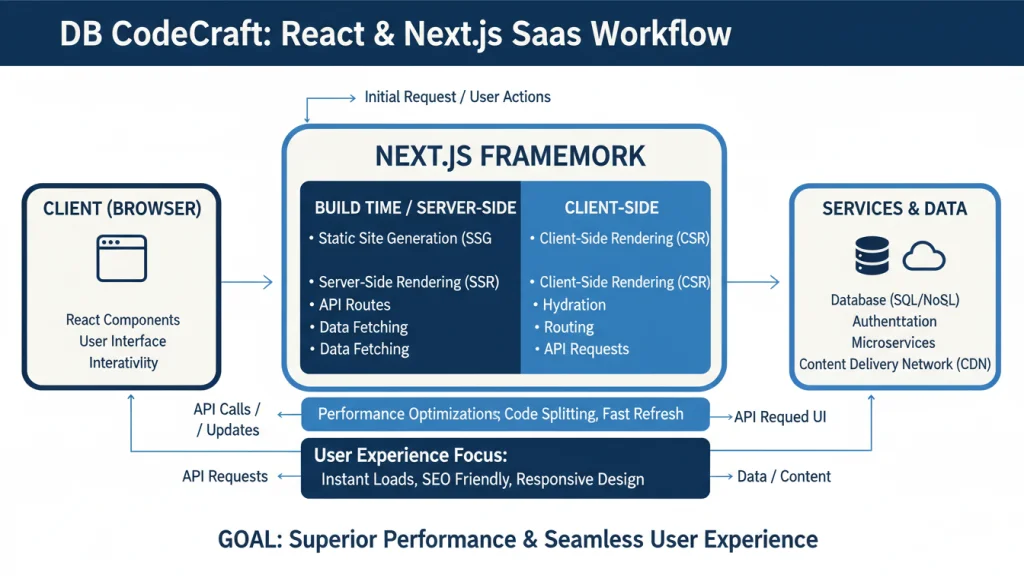
Performance is paramount for SaaS applications. Users expect instant loading times and seamless interactions. Next.js excels here, offering several rendering strategies:
- Server-Side Rendering (SSR): Pages are rendered on the server for each request, improving initial load times and SEO. This is ideal for dynamic content that needs to be fresh on every visit.
- Static Site Generation (SSG): Pages are pre-rendered at build time, resulting in incredibly fast loading and enhanced security. Perfect for static marketing pages or dashboards with infrequent data changes.
- Incremental Static Regeneration (ISR): A hybrid approach that allows updating static pages after they’ve been deployed, combining the best of SSG and SSR.
These strategies, combined with Next.js’s built-in image optimization, code splitting, and intelligent prefetching, ensure that your SaaS application delivers a blazing-fast and smooth user experience, critical for retention and satisfaction in competitive SaaS product development.
Building a Scalable SaaS Product Development Ecosystem
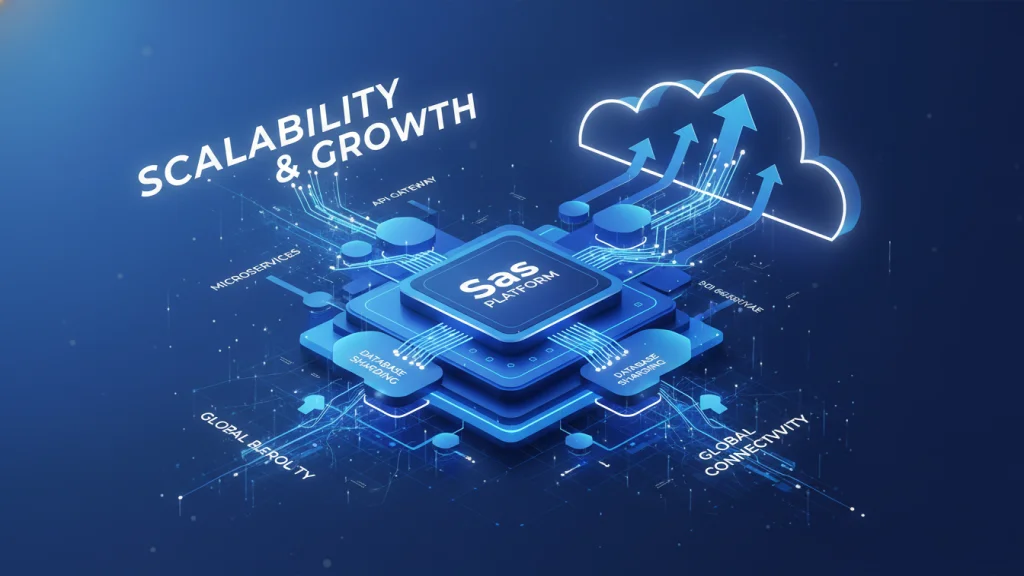
Scalability isn’t just about handling more users; it’s about the ability of your architecture to grow and evolve with your business without significant re-engineering. React and Next.js lay the groundwork for a truly scalable SaaS product development ecosystem.
Modular Architecture for Future Growth
The component-driven nature of React naturally encourages a modular approach. This can extend to a micro-frontend architecture, where different parts of your SaaS application are developed and deployed independently. This reduces coupling, improves team autonomy, and makes it easier to scale individual services. For instance, a dashboard, billing portal, and analytics module could each be a separate micro-frontend, allowing for specialized teams and faster deployments.
Integrating various services and APIs is also streamlined. Whether it’s connecting to third-party payment gateways, CRM systems, or your own bespoke backend services, the structured environment provided by React and Next.js simplifies API consumption and management. Explore how we craft tailored solutions for complex integrations on our IT Services page.
Secure and Robust Backend Integration
While React and Next.js primarily handle the frontend, their capabilities extend to robust backend integration. Next.js API Routes allow you to build serverless API endpoints directly within your project, perfect for handling form submissions, authentication, and data retrieval without needing a separate backend server. This full-stack capability streamlines development, especially for smaller teams or prototypes.
For more complex SaaS applications, React and Next.js seamlessly integrate with dedicated backend services built with technologies like Node.js, Python, or Go. Secure authentication (e.g., OAuth, JWT), robust data validation, and efficient database interactions (SQL or NoSQL) are critical components that can be expertly handled by a well-architected backend, ensuring the security and integrity of your SaaS data.
Overcoming Challenges and Future-Proofing Your SaaS
Every complex software project presents its unique set of challenges. However, the React and Next.js ecosystem provides mature solutions and best practices to navigate these hurdles and ensure your SaaS remains performant and adaptable for years to come.
State Management and Data Flow
As your SaaS application grows, managing its state can become complex. React offers its built-in Context API for simpler global state, while libraries like Redux, Zustand, and Jotai provide more sophisticated patterns for managing application-wide state, ensuring predictable data flow and easier debugging. Choosing the right state management solution is crucial for maintaining a clean, scalable codebase.
Testing and Quality Assurance
A robust testing strategy is non-negotiable for high-quality SaaS product development. React and Next.js applications benefit from a variety of testing approaches:
- Unit Testing: Verifying individual components and functions (e.g., Jest, React Testing Library).
- Integration Testing: Ensuring different parts of the application work together correctly.
- End-to-End (E2E) Testing: Simulating user interactions across the entire application (e.g., Cypress, Playwright).
Automated testing helps catch bugs early, maintain code quality, and provides confidence when deploying new features, which is essential for continuous delivery in SaaS environments.
Deployment and DevOps
Next.js applications are highly deployable. They can be hosted on traditional servers, serverless platforms (like Vercel, Netlify, AWS Lambda), or containerized environments (Docker, Kubernetes). Implementing robust CI/CD pipelines ensures that code changes are automatically tested, built, and deployed, minimizing manual errors and accelerating time to market. This streamlined deployment process is a hallmark of efficient SaaS operations.
“The ability to rapidly iterate and deploy features without compromising performance or stability is a cornerstone of modern SaaS success. React and Next.js empower teams to achieve this with remarkable efficiency.”
For a deeper dive into the technical intricacies of React, refer to the official React documentation. Similarly, explore the full capabilities of Next.js on its official documentation website.
Partnering for Success: DB CodeCraft’s Expertise
Navigating the complexities of modern SaaS product development requires not just technical proficiency but also strategic insight. At DB CodeCraft, we specialize in leveraging cutting-edge technologies like React and Next.js to turn your vision into a scalable, high-performing SaaS product.
Whether you’re a startup with a groundbreaking idea or an enterprise looking to innovate, our team provides end-to-end development services—from conceptualization and design to robust development and ongoing support. We understand the nuances of building applications that are not only functional but also secure, performant, and user-friendly.
Our approach focuses on collaboration, transparency, and delivering measurable results. We work closely with our clients to understand their unique business needs, ensuring the final product aligns perfectly with their strategic objectives. Our portfolio showcases a range of successful projects where we’ve applied these principles to deliver exceptional value. See some of our work and client successes on our Portfolio page.
Conclusion
React and Next.js offer an unparalleled toolkit for building scalable, high-performance, and user-centric SaaS applications. Their combined strengths in rapid development, optimized user experience, and robust architecture make them the ideal choice for businesses aiming for long-term success in the SaaS market.
Embrace the power of these technologies to build your next-generation SaaS product. Partner with DB CodeCraft to transform your innovative ideas into market-leading solutions that drive growth and deliver exceptional value in the realm of SaaS product development.